Round-the-clock Projects: 24/7 Renewables
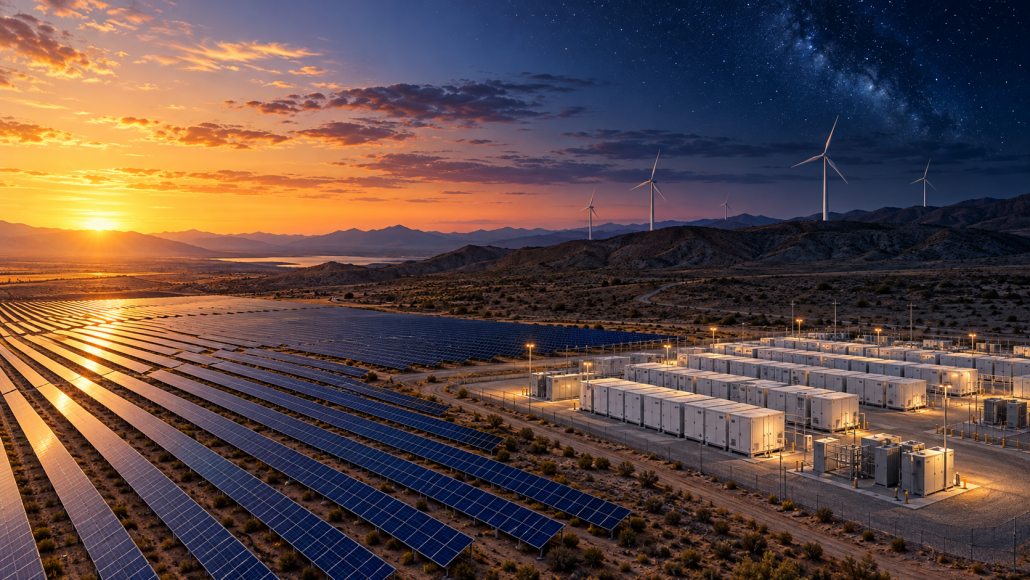
In July 2026, Masdar secured funding for a project that, just a few years ago, would have sounded like science fiction: 1 GW of constant renewable electricity, day and night, 365 days a year, in the heart of the Abu Dhabi desert and without a single gas turbine. These are known as round-the-clock (RTC) projects and are becoming increasingly common thanks to advances in battery and control technology. In this article, we’ll take a look at some of them and see if they make sense beyond the headline.
Firm generation: the latest challenge for renewables
Whilst until the early 2000s the challenge was to prove that renewable technology worked, this subsequently shifted to reducing the LCoE (and we went a bit overboard, by the way) and achieving grid integration (with such success that renewables can now act as active stabilising elements); the next major challenge is firm generation.
The inherent intermittency of renewables has been mitigated through various mechanisms:
- Generation forecasting: this made it possible to include renewables in auctions and eliminated uncertainty 24–48 hours in advance.
- Interconnection: the greater the geographical diversification of an interconnected system, the more likely it is that there will always be surplus resources and generation somewhere to compensate for others.
- Hybridisation: combining different technologies with complementary generation patterns or storage capacity increases a system’s capacity factor. The best example is solar and wind power, with their day/night cycles, and batteries installed alongside renewable projects.
The novelty of these RTC projects is that they promise 24-hour firmness without resorting to interconnection between regions, but solely through a technological mix at the same site. This makes them ideal solutions for decarbonising remote, off-grid sites such as mines.
Types of 24/7 projects
Before we begin, it is worth clarifying the different types of renewable projects known as 24/7:
- Round-the-clock (RTC) or renewable baseload: the project is contractually committed to delivering a constant (or near-constant) power output 24 hours a day. This is the case with the Masdar RTC project in Abu Dhabi.
- 100% renewable off-grid: projects not connected to the grid, whose sole sources of generation are renewable. The best-known examples are mines such as the Pilbara–Fortescue mine in Australia.
- Firm & Dispatchable RE (FDRE): the Indian version of the concept. It is not necessarily flat; rather, the developer must follow the demand profile set by the distributor, with guaranteed minimum availability levels.
- Time-of-use manageable: hybrid systems that guarantee power during the hours most relevant to the system, but not throughout the night.
These categories are not mutually exclusive, as RTC and FDRE refer more to the supply that is committed, whilst Offgrid describes how the system is connected.
But let’s look in detail at two of the most interesting examples from the RTC and Offgrid categories
Masdar RTC – Abu Dhabi
The project figures are staggering:
- 2 GW of photovoltaic capacity: assuming this figure also represents the DC power (the DC power is likely to be slightly higher but has not been published), this would amount to over 8 million modules from JA Solar and Jinko.
- 19 GWh of batteries: although it was initially announced that CATL would supply them, the mega-project has ultimately gone to Sungrow’s PowerTitan 3.0 and BYD. In total, there will be more than 2,000 battery containers, which, if lined up end to end, would stretch for 12 kilometres. Incidentally, BYD will be using one of the highest-capacity commercial containers on the market, the Haohan, with a capacity of 11.275 MWh per container
- 2 GW of solar inverters: half of these will be supplied by Sungrow.
- 4 GW of battery PCS: to achieve a charge time of 8 hours and a discharge time of 16 hours. 1 GW from Sungrow (already integrated into its PowerTitan 3.0 solution) and the rest likely from BYD.
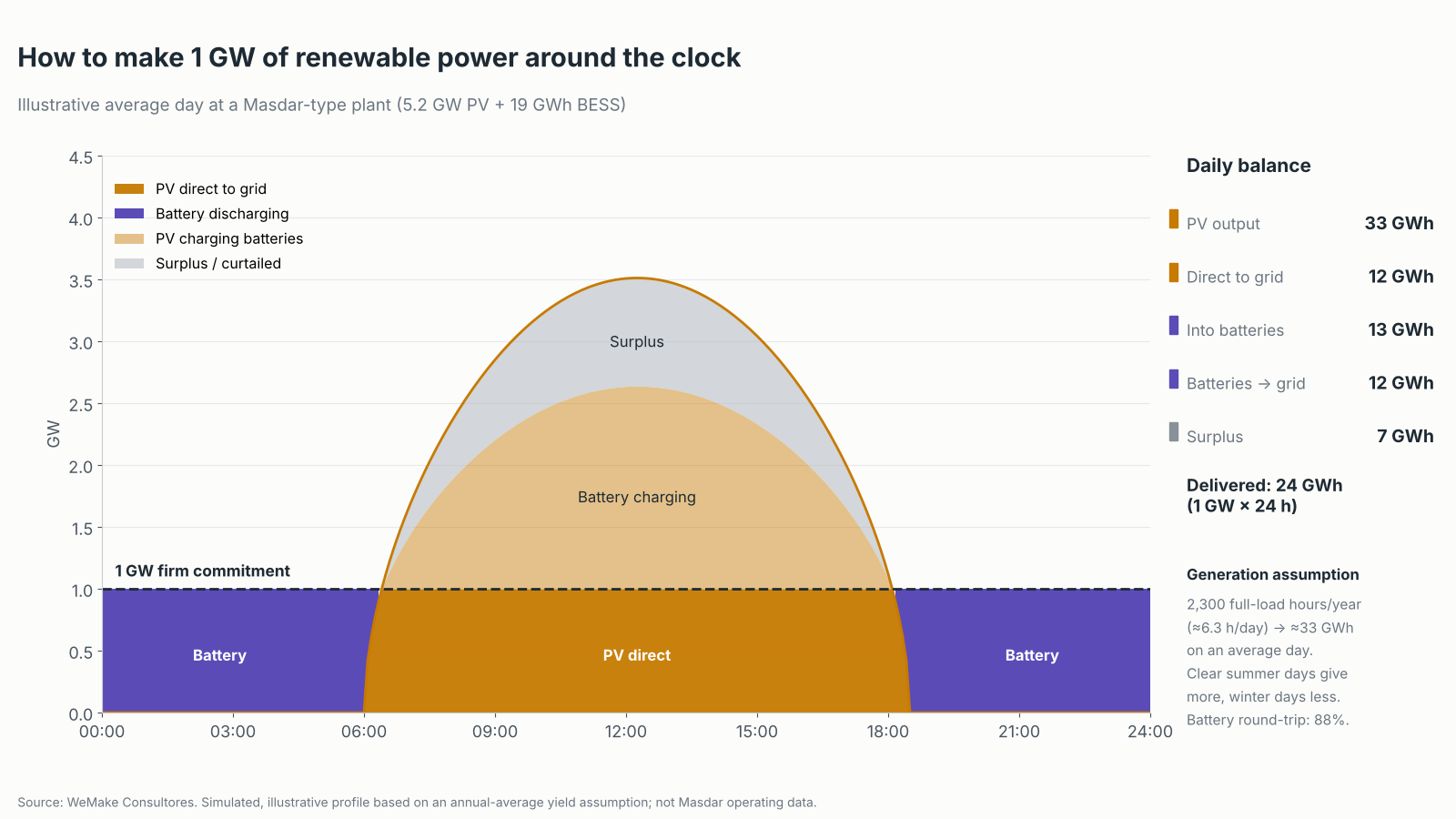
So how will this project work?
Well, if we do a quick calculation on the back of a napkin, we can work it out:
- 1 GW needs to be generated over 24 hoursà 24 GWh/day
- Assuming 2,300 net equivalent hours (a very good estimate), that’s 6.3 equivalent hours of solar production per dayà 33 GWh
- However, of that output, only around 12 GWh is fed into the grid, as the connection is limited to 1 GW (the agreed supply)
- The remainder is used to charge the batteries. Although the maximum capacity is 19 GWh (8 hours of charging at maximum power), we assume that on average 13 GWh is charged
- Those 13 GWh are fed into the grid during the 13 hours when there is no sunshine, with 90% efficiency, yielding the 12 GWh that make up the 24 GWh
And what happens on winter days with fewer hours of sunshine?
The system has to be sized for the worst-case scenario. Hence its extreme oversizing: 5 times for the PV and almost double for the batteries
What about cloudy days?
Well, it’s not clear. Perhaps a cloudy day can be managed with the extra energy stored in the batteries plus residual generation, but if there are several consecutive days without sunshine, it doesn’t seem possible to maintain generation. This project lacks some wind power to reduce the likelihood of days without a power source.
Although the average figures add up, it seems clear that, with this configuration, it will be difficult to meet the supply commitment every hour of the year.
Fortescue – Australia
Source: Fortescue
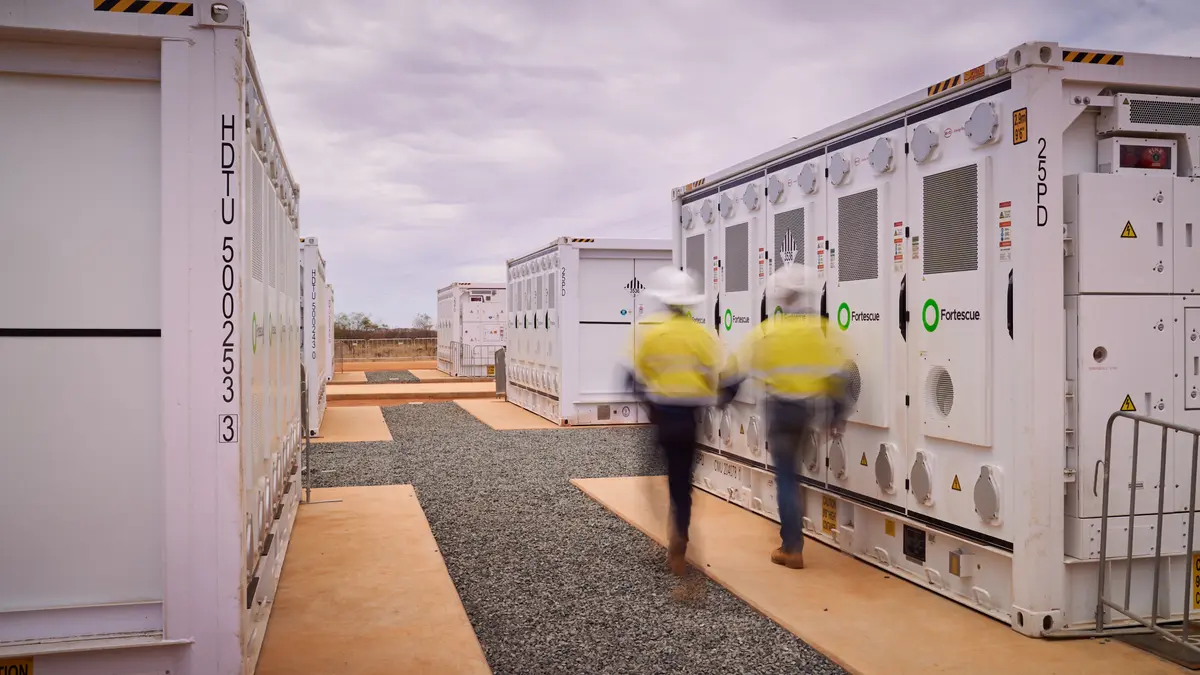
Fortescue is implementing one of the world’s most ambitious industrial decarbonisation projects, as it aims to completely eliminate its emissions related to iron ore mining in the Pilbara region by 2028. Electrification of operations, 100% renewables, green transport… it’s a project that has it all, and one to which we will almost certainly devote a full article on this blog. To achieve 100% renewables, they are following a strategy combining a mix of technologies and geographical diversification:
- 1,500 MW of solar farms spread across five sites. 500 MW are already operational and a further 690 MW are under construction
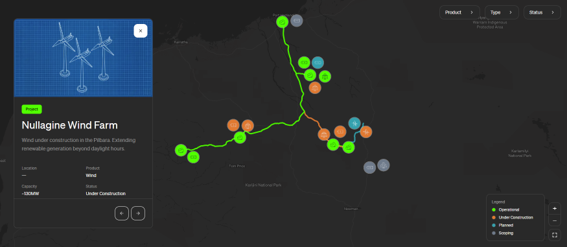
- 900 MW of wind power spread across several sites: the first wind farm (Nullagine Wind), with a capacity of 133 MW, is already under construction and is notable for being equipped with innovative 188-metre towers from Nabrawind – a Navarre-based company recently acquired in full by Fortescue itself – alongside Envision EN182/7.8 MW turbines.
- Up to 5 GWh of battery storage: 370 MWh is already operational, and the CloudBreak 74 MW/650 MWh mega-battery is under construction. It will be able to deliver 74 MW for over 8 hours, providing cover for the entire night.
- 620 km of power transmission lines to connect the generation points to the mines, of which 550 km have already been built
The investment required for this colossal project is $6,200 million.
The company has an interactive map showing all the project sites, along with their characteristics, status and configuration. As can be seen, the various sites are quite far apart, which reduces the need for oversizing (provided the connection networks are properly calculated).
Source: Fortescue
Why are RTC projects viable now?
We have already seen two spectacular examples of RTC projects, but why are they viable now? There are two key reasons
- There are customers willing to pay the premium
- AI data centres. No formal offtake agreement has been announced, but EWEC and Masdar make no secret of the fact that the Abu Dhabi RTC is designed to turn the UAE into an artificial intelligence hub. The so-called hyperscalers need green energy 24/7 to mitigate the impact of data centres and are willing to pay for it.
- Mining and heavy industry. In remote locations, every litre of diesel saved pays for the battery. Fortescue estimates annual savings of $818 million in diesel costs from 2030 onwards.
- Technology has improved significantly
- More efficient and cheaper solar panels
- Larger and more efficient wind turbines: enabling large-scale projects with fewer units
- Large-cell LFP batteries. Cell capacities have jumped from 280–314 Ah to 500–684 Ah, with containers exceeding 6 MWh. In fact, as mentioned above, BYD is set to use 11 MWh battery containers. Fewer containers, less cabling and lower O&M costs per MWh installed: without this fall in costs, 19 GWh in a single project would be unthinkable.
- PCS and grid-forming inverters. When a plant aims to behave like a conventional power station – particularly in weak or isolated grids – it is no longer enough simply to follow the grid: it must help shape it. We already advocated this following the major blackout, and indeed, one of the examples we cited at the time – the 1.3 GWh microgrid at Red Sea in Saudi Arabia – is the direct precursor to these RTCs.
- Advanced hybrid plant controller (PPC/EMS). This is the ‘brain’ that decides at any given moment how much power goes to the grid, how much to the batteries and how much is fed into the grid, taking into account weather and price forecasts. In hybrid wind-solar systems, this is more critical than ever.
In conclusion, it is clear that these are not simple (or cheap) projects, but they should be seen as demonstrations of what renewable technology is capable of achieving. The question is whether the enormous effort and over-engineering required to achieve that 24/7 operation is worth it. Perhaps we should opt for solutions that are 80–90% renewable, which are much cheaper and simpler, because there will always be time to reach 100% in the future, perhaps with new technologies.