
Offshore orders slump: is there cause for concern?
Since mid-2023, the pace of new offshore orders for the two major Western manufacturers — Siemens Gamesa (SGRE) and Vestas — has been, to say the least, erratic. Of the last six quarters (Q1 25–Q2 26), Vestas has recorded zero new orders in three, and SGRE in five out of six. In the most recent quarter for which full data is available, neither manufacturer secured a single new order. Given these figures, questions naturally arise: is the offshore market in crisis? Could this slump affect the market’s future viability? In this article, we will attempt to shed some light on these and other issues.
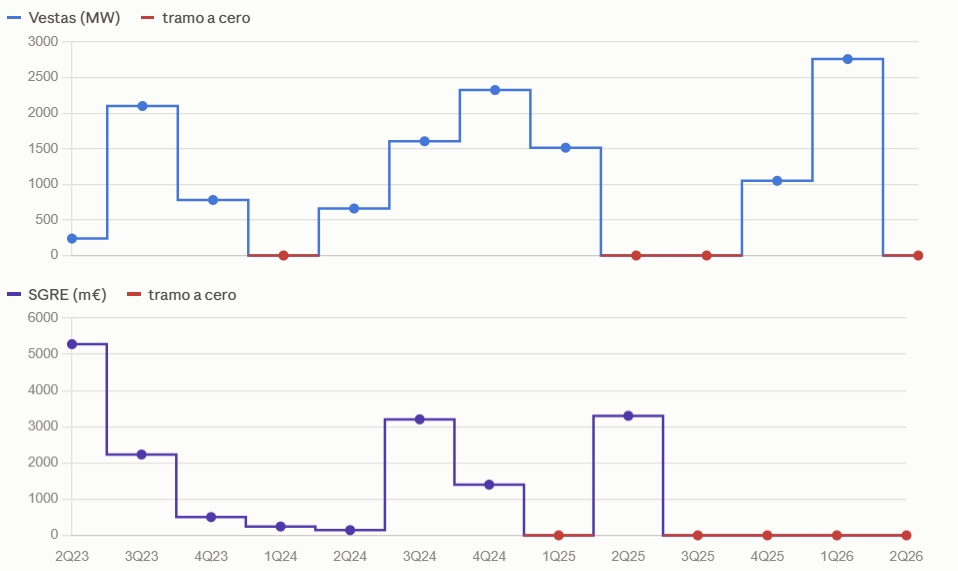
Quarterly order intake for SGRE (m€) and Vestas (MW), Q2 23–Q2 26. Source: own analysis based on publicly available quarterly results data.
Why has the flow of orders dried up?
There are several factors that help explain this current drought in orders. None is solely to blame, but all have contributed to the slowdown in the usual flow of orders
- Auctions cancelled, delayed or unsuccessful
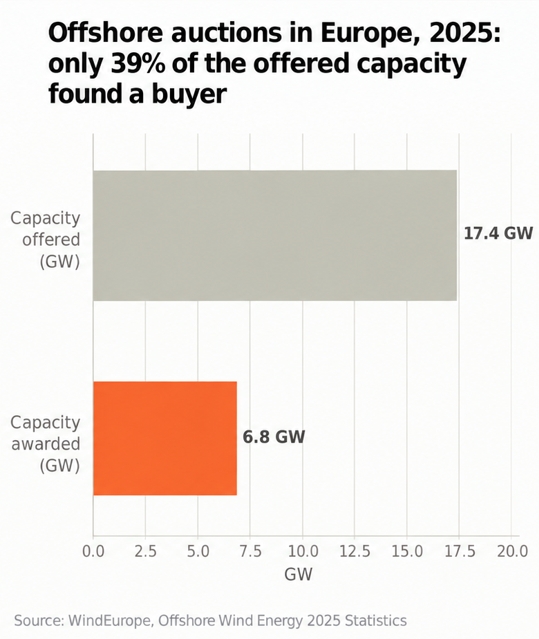
According to WindEurope, 2025 was the year in which the most offshore capacity was put up for auction in Europe and the least was successfully allocated: over 17 GW was put out to tender and only 7 GW was awarded, representing 39 per cent of the total planned.
The list of failed processes is long and affects almost all the major markets:
- Denmark cancelled Hesselø, Kattegat II, Kriegers Flak II and Sørvest F
- France received no bids for AO7-Oléron 1
- Germany received no bids for the two central lots, N-10.1 and N-10.2, and, following this failure, decided to postpone the auction until 2027 whilst redesigning the mechanism towards a two-tier CfD
- The Netherlands also received no bids for Nederwiek Zuid I-A and has had to scale back its next auction from 2 GW to 1 GW, explicitly citing rising costs in the sector.
The pattern is repeating itself: auctions designed to minimise costs or even generate revenue for the state (known as ‘negative bidding’) make no sense at present. All governments have taken note and are redesigning competitive processes to raise prices and provide greater certainty for developers. The UK is the best example of how, when prices are brought into line with reality, demand returns: its AR7 round (January 2026) awarded a record 8.4 GW — the largest offshore tender in the country’s history — with RWE securing 6.9 GW at €109/MWh and SSE 1.4 GW at €107/MWh, prices significantly higher than in previous rounds.
- Delayed or cancelled projects
The most high-profile case in 2025 is that of Ørsted, which in May ruled out proceeding with Hornsea 4 (2.4 GW) in its original form, citing “adverse macroeconomic developments, persistent supply chain challenges and increased execution and market risks”. The cost of the decision — including compensation for breach of contract and asset impairment — stands at around €740 million. Ørsted is retaining the rest of its UK portfolio (Hornsea 3, 2.9 GW) and has not ruled out resuming work on Hornsea 4 should conditions improve.
On a broader scale, WindEurope confirms that only six wind farms reached FID in 2025 across Europe (Nordlicht 1, Baltica 2, BC-Wind, Baltyk II, Baltyk III and Inch Cape, totalling 5.4 GW and €22,500 M in capex), well below the pace required to sustain projected growth. Ten further FIDs are expected in 2026, suggesting that the problem is more one of timing than of projects being scrapped.
- Rising costs: the end of the era of zero or negative bidding
In line with what was mentioned earlier, the general rise in offshore costs has led developers to be much more cautious when bidding for sites and tariffs. The frenzy seen a few years ago, with companies paying for the rights to build a wind farm, is now unthinkable, and developers are seeking high tariffs with safety mechanisms such as CFDs (contracts for difference) to ensure a minimum return on the project.
- Markets with their own problems: the case of the USA
The United States is the most extreme example. An executive order in January 2025 suspended offshore wind leasing on the Outer Continental Shelf (OCS), and the Bureau of Ocean Energy Management (BOEM) cancelled all wind areas designated since 2014; furthermore, the federal government ordered the halt of construction on five projects on safety grounds. GWEC sums it up as follows: “We believe that offshore wind has no future under the current administration.” What does remain on track are projects already at a very advanced stage: Vineyard Wind 1 was completed in early 2026, and a further ~5 GW (Revolution Wind, Coastal Virginia, Empire Wind 1 and Sunrise Wind) are expected to come online between 2026 and 2028. However, virtually no one in the sector expects any new capacity to be awarded in the US after 2028–2029.
In fact, the Trump administration is buying back rights from developers to nip any possibility of the market reviving in the future in the bud.
- The withdrawal of the ‘oil & gas’ sector
A few years ago, there was talk within the sector about the inflation being caused by the major oil companies with offshore operations, as they were in a great hurry to build their pipeline and were paying above-market prices to secure projects. But this is now a thing of the past, as companies such as BP and Shell are pulling back from offshore wind as part of a broader shift towards oil and gas: BP has been ceding ground in the US and, in July 2025, sold its entire onshore wind business in the US. Shell, for its part, withdrew from Atlantic Shores (New Jersey) in November 2025, transferring its stake to its partner EDF.
The litmus test: let’s take a look at the current pipeline
Against this pessimistic backdrop, it is worth looking at the other side of the coin: just how much activity is actually underway. If we look at current projects (excluding China) according to their stage of maturity and grouped by OEM, we get the following picture
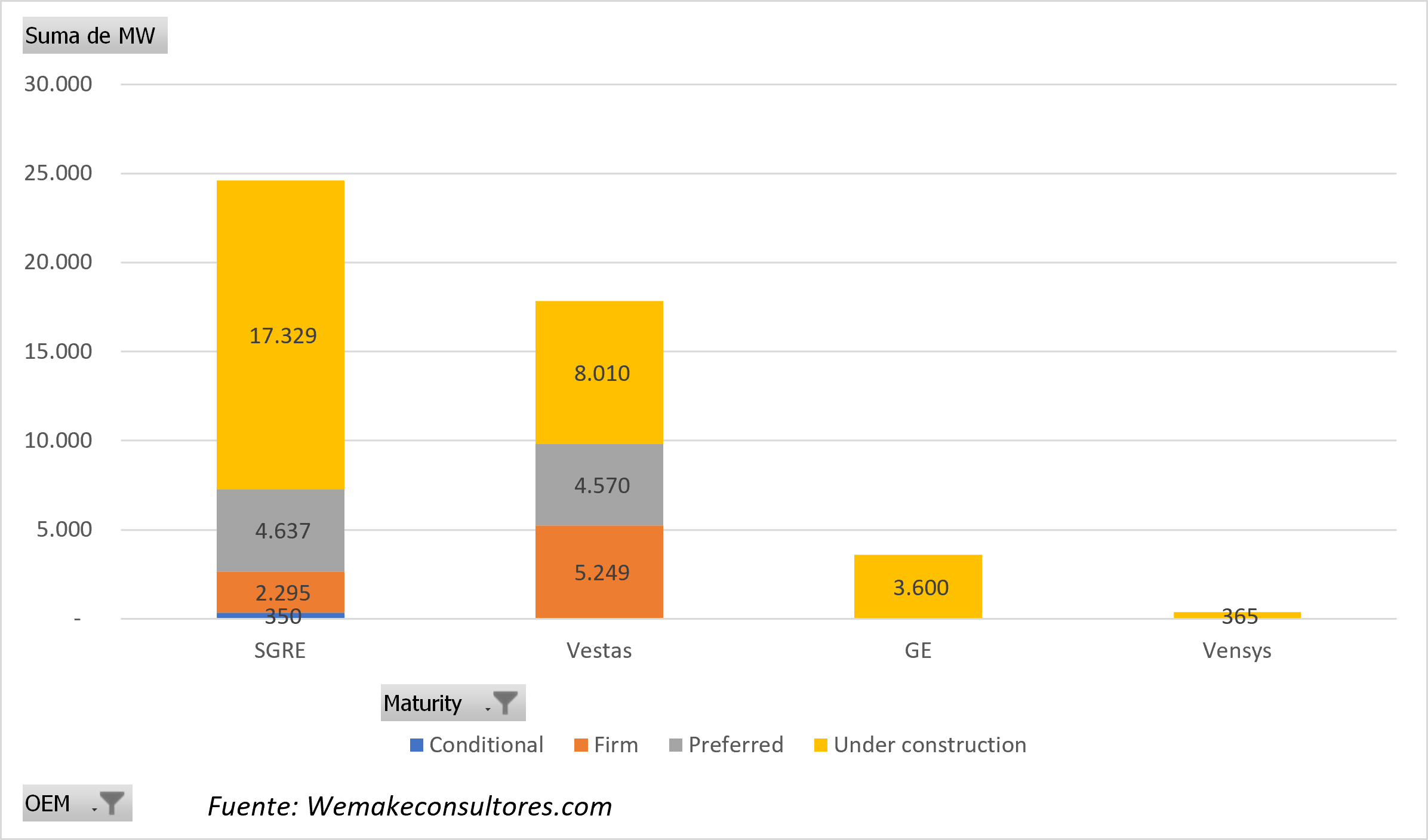
In total, there are 46 GW in the active pipeline across the four manufacturers with significant operations outside China: nearly 30 GW under construction, 9 GW in the form of non-firm contracts and 7.5 GW as firm projects. Siemens Gamesa stands out for its large volume of projects under construction, totalling over 17 GW.
What this chart makes clear is that the sector is certainly not at a standstill. Activity is frenetic; this may well be a historic moment marking a peak in activity.
How many years will this portfolio last?
Well, here we have to make some assumptions to arrive at a rough estimate. Starting with the average installation rate in recent years (excluding China), which has been 3.8 GW
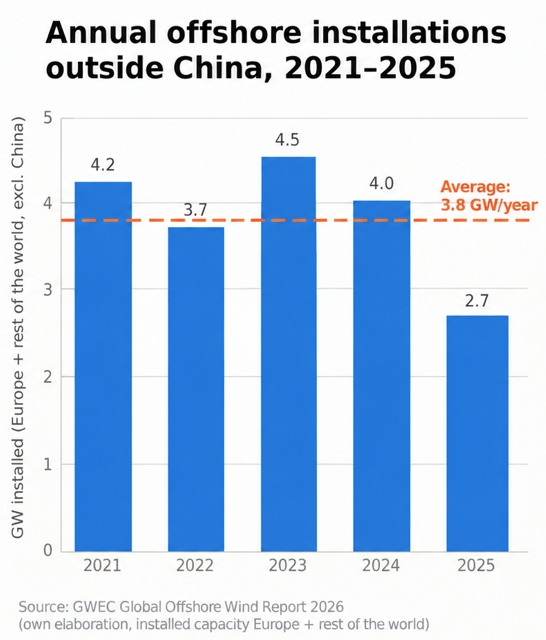
If this rate were to continue, the 46 GW (assuming the conditional contracts were to be executed) would last for around 12 years. However, as many projects are already under construction, we know that activity over the coming years will be much higher than those 3.8 GW. Assuming the 30 GW currently under construction are completed within the next three years, we would have 10 GW per year until 2029, after which activity could stabilise at 6 GW per year, meaning we would be covered until well beyond 2031.
It is clear that, despite the slowdown in recent quarters, there is no shortage of projects for the coming years.
What demand lies ahead?
Beyond what is already in the pipeline – which, as we have just seen, is substantial – there are two sources of additional demand that should continue to feed the pipeline beyond 2030.
- Auctions that have already been concluded or announced. The United Kingdom has just awarded the aforementioned 8.4 GW under AR7 and will launch AR8 in the second half of 2026. Poland awarded 3.4 GW in December 2025 (Baltic East, Baltica 9 and Baltyk I). Denmark has launched an auction for at least 2.8 GW under the new two-tier CfD model, with deadlines in 2026 and 2028. Germany will reopen N-10.1 and N-10.2 (2.5 GW) in 2027 under the redesigned mechanism. France has AO9 underway (1.5 GW, results in H1 2026) and is preparing AO10, for 8 to 10 GW. The Netherlands will launch a 1 GW tender in September 2026. South Korea, for its part, launched a first batch of 689 MW in 2025 and plans to award around 1.8 GW in the first half of 2026.
The common thread running through all these calls for tenders is that they follow a round of reforms: more realistic reference prices, two-tier CFDs to spread the risk in both directions, and better-calibrated local content criteria to avoid a repeat of the pattern of unsuccessful auctions seen in 2025.
- New markets from 2030 onwards. In the short term, we are not going to see any new markets, but in the medium to long term we should start to see new countries entering the offshore sector: India, Vietnam, the Philippines, Spain, Brazil… We know it is not straightforward and that it is a process that takes time, but around 2035 we could see demand from some of these countries.
Conclusion
The current drought in orders is not good news in itself – no manufacturer wants to go five out of six quarters without making a sale – but neither is it a sign that the structural demand for offshore wind has disappeared. The most important point is that we are at peak levels of offshore activity and that this drought in orders may even be positive in giving the supply chain some breathing space, allowing it to clear a backlog that was building up.
Nobody wants to see quarters without orders, but given the pipeline that OEMs have, there will be no problem in filling these gaps with existing projects, meaning we won’t see any significant drops in activity. Furthermore, the new auctions ensure that the pipeline will continue to be fed, and as for future opportunities, we have new markets that are already turning their attention to offshore wind.
In short, there’s no need to panic because offshore is here to stay for the foreseeable future.


