
The value of wind power: prices captured by wind power in Spain

Due to the intermittent nature of renewable energies, the average price at which they sell their electricity does not necessarily coincide with the average price on the electricity market. To measure this, the concept of captured price is used, i.e. the weighted average price for production in each period. And this captured price can differ greatly from the average market price, so in this month’s article we will investigate the price of wind power in Spain.
What is the captured price?
The daily electricity market operates with prices assigned for periods of the day. Currently, these periods are hourly, but there are already European plans to change them to quarter-hourly. In each period, a single market price is set, determined by the last bid necessary to meet demand (the marginal bid). All producers matched in that period receive the same price. This is what is known as a marginalist system.
Due to their intermittent nature, renewables offer energy during periods when they expect to have resources available for production, usually at very low prices to ensure their matching. The captured price is the weighted average of these periods.

The capture rate is the ratio between the captured price and the average market price.
What is the capture rate for each technology?
Capture rates will depend greatly on the production pattern of each technology. Nuclear, for example, whose production is almost continuous and uniform throughout the day, will have a captured price of around 100%, while other manageable technologies such as gas can even exceed 100% by producing only at times of high prices.
Renewables, however, are limited by the availability of resources. The most extreme case is solar, which only produces during daylight hours and, given that these hours coincide with high solar production and abundant renewable generation, this puts downward pressure on prices, resulting in a very low captured price. This effect is known as “price cannibalisation”.
Solar energy is the best example of the cannibalisation effect, with captured prices falling as its penetration grows. In 2025, solar energy only managed to capture 54% of the average price, as explained in this excellent article.
Does wind power suffer from this price cannibalisation?
Wind power production patterns are much more varied than solar power, so it is to be expected that its capture rates will be higher. The best way to represent this visually is with an hourly heat map:


The central area of the graphs is clearly darker, showing where solar power causes prices to plummet. However, wind power achieves high prices in the hours just before dawn and just after dusk, when solar power is no longer producing and demand is growing.
It can also be seen that April and May are months with low prices throughout the day, as they are traditionally months with high hydro and wind power.
Historical evolution
If we analyse the evolution over recent years, wind power has capture rates of around 90% of the average market price, which are relatively high values for an intermittent renewable technology.

The maximum was reached in 2017 with 97% and the minimum in 2023 with 87%.
Comparing these figures with solar (54% in 2025 and 66% in 2024), we understand why developers prioritise wind assets as they are highly viable even with high merchant exposure. This is what is commonly referred to in the sector as ‘the value of the wind megawatt‘.
The role of economic curtailment
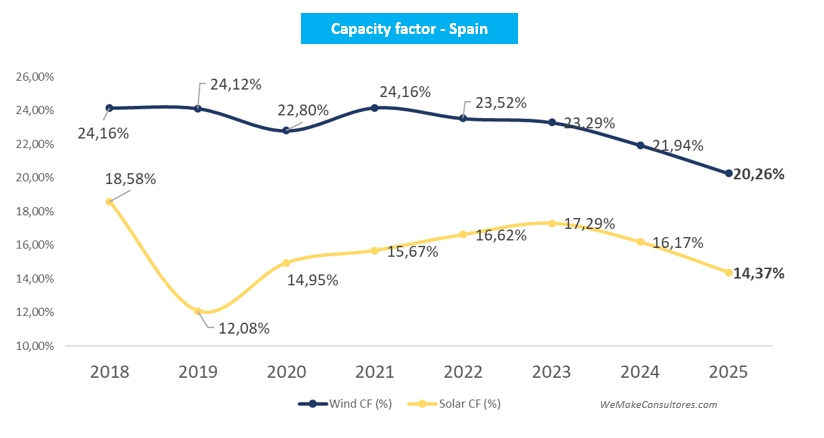
Although it is difficult to know for sure, it is very likely that, in order to maintain these high capture rates in recent years, wind producers have had to sacrifice part of their production during hours of zero or negative prices, which is called “economic curtailment”. The decline in net wind production and therefore in the capacity factor in recent years is perhaps partly due to this phenomenon.
What is happening in 2026?
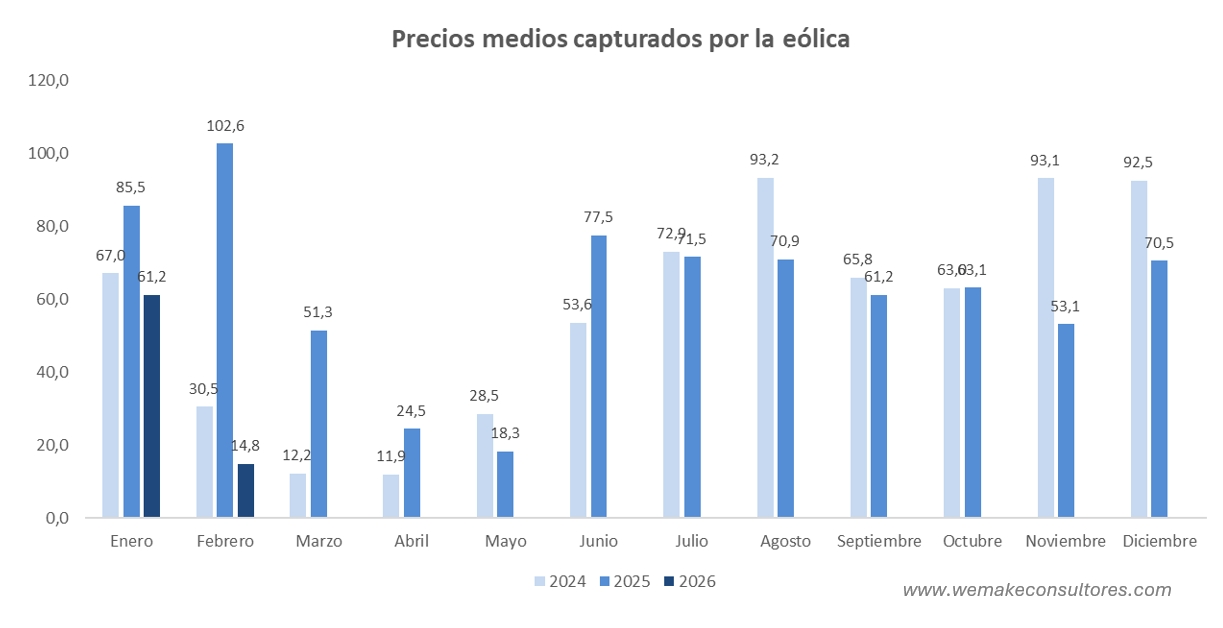
If we look at the daily evolution so far in 2026, the prices recorded have plummeted since the end of January, mainly due to high hydroelectric production.

If we compare the start of this year with 2024 and 2025, we see that prices in the first two months have been lower than in previous years. In addition, there is great variability throughout the year, in line with average market prices.
Do these prices affect all wind projects?
Not necessarily. The prices captured mainly affect projects exposed to the free market, i.e. those that sell all or part of their production directly on the daily market. However, many wind farms have regulated tariffs (from auctions) or private PPAs, which stabilise their revenues.
Even so, the captured price remains a good indicator of the economic value of the technology, and therefore a key benchmark for assessing the viability of new projects.
Conclusion
In recent years, wind power has managed to maintain relatively high capture rates, even in an electricity system increasingly dominated by solar generation.
Its production pattern, which is more evenly distributed throughout the day, allows it to partially avoid the cannibalisation effect that strongly affects solar power.
Added to this is probably greater production management by operators, including possible economic curtailment decisions at times when prices are very low or negative.
All this explains why, even in a system with growing renewable penetration, wind power continues to maintain a high economic value in the electricity market.


